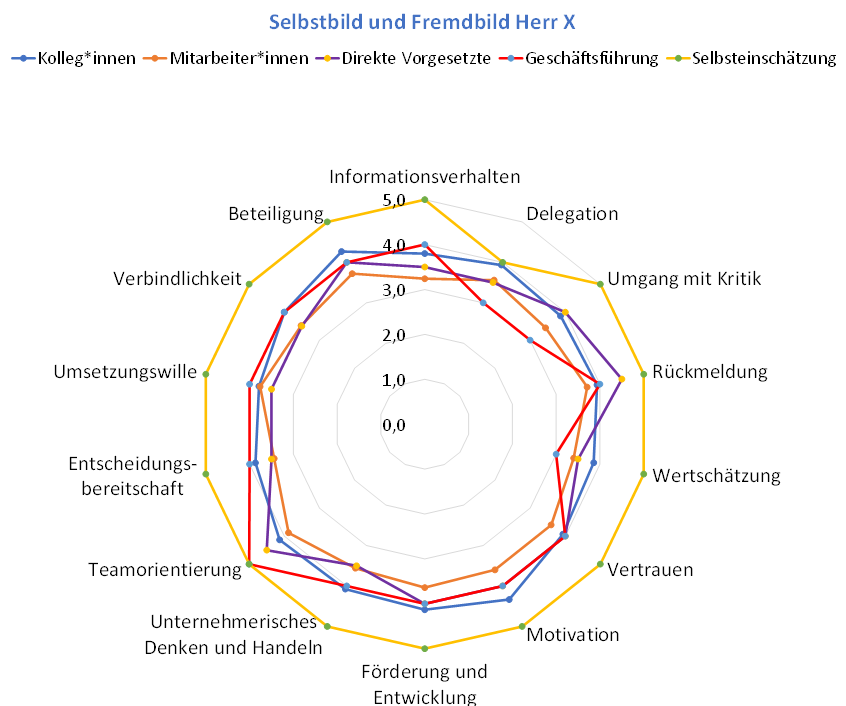
Leadership feedback & 360-degree feedback
In a leadership feedback session, employees have the opportunity to give their supervisor feedback on their perception of their attitude, behavior, actions, and performance. Feedback is not about "facts," but about the employee's perception. Feedback is constructive when it is expressed respectfully and objectively, contains concrete suggestions for improvement for the manager, and thus reveals additional behavioral possibilities. Through constructive feedback
Misunderstandings between managers and employees can be eliminated.
Relationships and conflicts can be resolved,
Trust and team spirit are strengthened permanently within the team.
People are supported in their professional and personal development,
It sensitizes one's own perception of personality.
Experiences with leadership feedback
In many companies, employees provide feedback to their managers. The underlying principle is that a manager can only be successful if their employees "follow" them. The relationship, therefore, must be positive. This is only possible if both sides understand each other's expectations and desires. Such manager feedback also has the added benefit of enabling the manager to develop professionally. However, this requires that employees are familiar with the feedback technique and that the manager has a genuine interest in their employees' opinions. Typically, a manager gathers such comprehensive feedback at least once a year. This usually follows a company-wide established process. The feedback takes place within the framework of a workshop, which typically also addresses other team-related matters. A well-managed company allocates an annual budget for this purpose. Depending on the level of trust between the manager and employees, the feedback process in practice is more or less open. The following approach to establishing leadership feedback is conceivable: After the process is introduced in the company, all participants are initially skeptical. Therefore, the feedback is initially conducted anonymously using questionnaires. The manager receives a self-assessment questionnaire, and the employees receive a questionnaire to evaluate the manager. With increasing experience, the feedback can become more open. After several rounds, it could then become commonplace for employees to openly place points on a "spider diagram" (e.g., a flip chart) in front of their supervisor during the workshop. The individual points are then discussed. Finally, several areas are identified in which the manager should develop further in the coming year. This task is then incorporated into the manager's performance agreement. The success of this process is reviewed during the next leadership feedback session.
360-degree feedback
In this special form of leadership feedback, not only employees but also superiors, colleagues, business partners, and customers can provide feedback. This reveals different perspectives on the leader's attitude and behavior. A differentiated external perception can thus be compared with the leader's self-perception. This process can also include analyses of current and desired performance.
Our consulting topics
Development of a customized feedback concept: Based on your requirements, we will create a concept for your management feedback.
Feedback workshops: We moderate feedback workshops according to your requirements.
Development of survey instruments: For written surveys, including 360-degree feedback, we offer modern, freely editable software solutions. If required, we also conduct surveys using traditional questionnaires.
Conducting the surveys: We survey the employee groups, compile the results in clear diagrams and inform them about the results in workshops.
Follow-up measures: If required, we offer workshops and coaching as part of target group-specific leadership development.