Understanding leadershipOctober 23, 2015
Understanding leadership – Part 6: Leadership in clinch and vicious circle

How do adults voluntarily and gladly submit to leaders' claims to rule?We can partly answer: people with leadership ambition activate archetypes of rule and submission. I showed this with Father, Hero and Saviour archetypes. The second part must be:
How is this interplay of rule and submission sustained and even deepened over time?
Interaction
Here something locks into a self-confirming loop. If I smile at you in the street, you may smile back or look away thinking "what does he want…" Either way my smile influences you—and your behaviour influences me: perhaps we chat over coffee, perhaps I look down thinking "another person who dislikes me…" It starts with humans not being able to live without others. We inevitably contact each other—family, tribe, nation or company: we enter relationships and interaction, mutually shaping behaviour. Daily choices sit in a web of influences from others, social context, upbringing and culture—and we are part of that web for others. Over time we adjust and learn roles in life's script, legitimise and expand them—unless reflection or rupture opens new paths.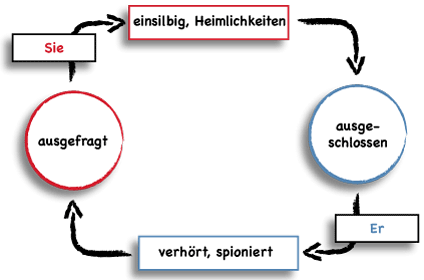 Vicious circles
Paul Watzlawick coined the term vicious circles for this. Schulz von Thun illustrates with a couple: the man feels excluded, spies on his wife; she withdraws, is monosyllabic, keeps secrets; he spies more. Watzlawick's pragmatics of punctuation: "Because he is distrustful, I withdraw" vs "Because she withdraws, I become distrustful"—opposite causal readings.

Clinch and double bind
This applies to leadership too: "Because he controls us, we slack when he's away" and "Because my staff keep taking breaks, I must control them strictly." Or "My boss trusts me with nothing, I feel insecure" and "You have to tell him everything twice." Or "My boss is the greatest, does everything—I could never" and "I must do everything alone." Partners get stuck in a clinch and eventually fit like lid and pot. Norbert Elias called this "double bind". I know firms where HR and works council fought for years in clinch; when one partner leaves, the other often collapses too—they need each other to secure their world view.Leading and being led reinforce each other
Leading and being led are mutually dependent like all relationships. Yet much leadership research treats leadership as an objective measure depending only on the leader. Theories, methods and tools centred solely on leaders fall short—they ignore followers and show only one side of interaction. Want details on interaction and clinch? Join the next posts on human behaviour in social systems.Teilen:
Questions about this topic? Reach out to us - the intro call is free and without obligation.
Schedule callComments
No comments yet. Be the first!