INQA Coaching: A support program for small and medium-sized enterprises

Current challenges for SMEs:
Digitalization, demographic change, staff shortages due to illness, and a lack of young talent – the technological and personnel challenges facing companies are manifold. Attracting and retaining skilled workers, in particular, are challenges across all sectors. Small and medium-sized enterprises (SMEs), however, often lack the resources to test innovative ideas, respond with tailored strategies, and find appropriate solutions.
What is "INQA Coaching"?
For this reason, the Ministry of Labour, together with the European Social Fund, has been running programs for several years that enable SMEs to access consulting services at significantly reduced prices. The latest funding program is "INQA Coaching," launched by the New Quality of Work Initiative (INQA) . It is financed by the Ministry of Labour and the European Social Fund. As consultants and business coaches, we have been helping companies overcome their challenges in leadership, personnel development, and digitalization for many years. Within the framework of funding programs for small and medium-sized enterprises, we have also worked in the medical and nursing sectors, among others. With the new "INQA Coaching" funding program, the scope of funding has been expanded, and the following now applies:
The funding framework of "INQA Coaching"
Companies with up to 249 employees can engage authorized coaches who will launch agile coaching projects with their employees, tailored to the company's specific needs. Up to 12 daily rates of €1,200 can be claimed within a six-month coaching period. 80% of the costs are then reimbursed from program funds.
Consulting topics
The possible topics for consultation are diverse:
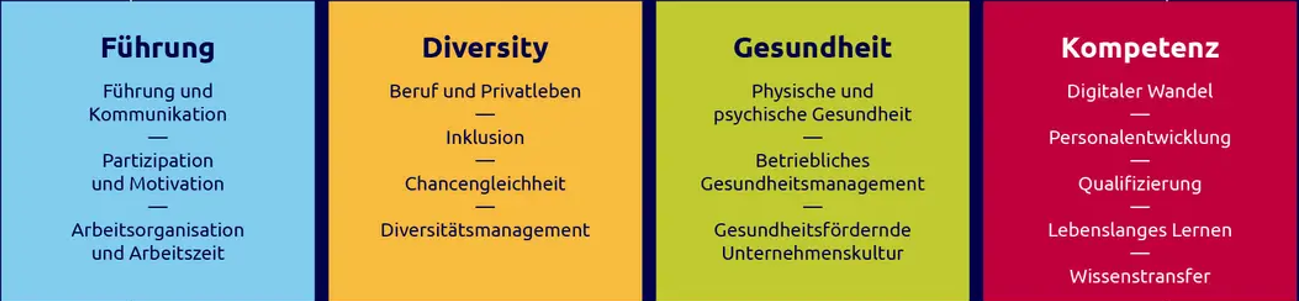
Examples of INQA coaching projects
Are you a small or medium-sized enterprise? Then you can take advantage of government-subsidized consulting services. I would be happy to assist you personally with this.
For example, in agile work phases, you will test your digitization ideas together with me as an authorized INQA coach and set the most important milestones for digital efficiency.
Or we can work together to find innovative strategies for developing your staff.
We help you improve the leadership quality in your company.
They reduce sick leave and attract new staff by increasing motivation and work quality.
With knowledge management strategies, you increase the skills of your employees and ensure that important knowledge remains within the company.
How does an INQA coaching project work?
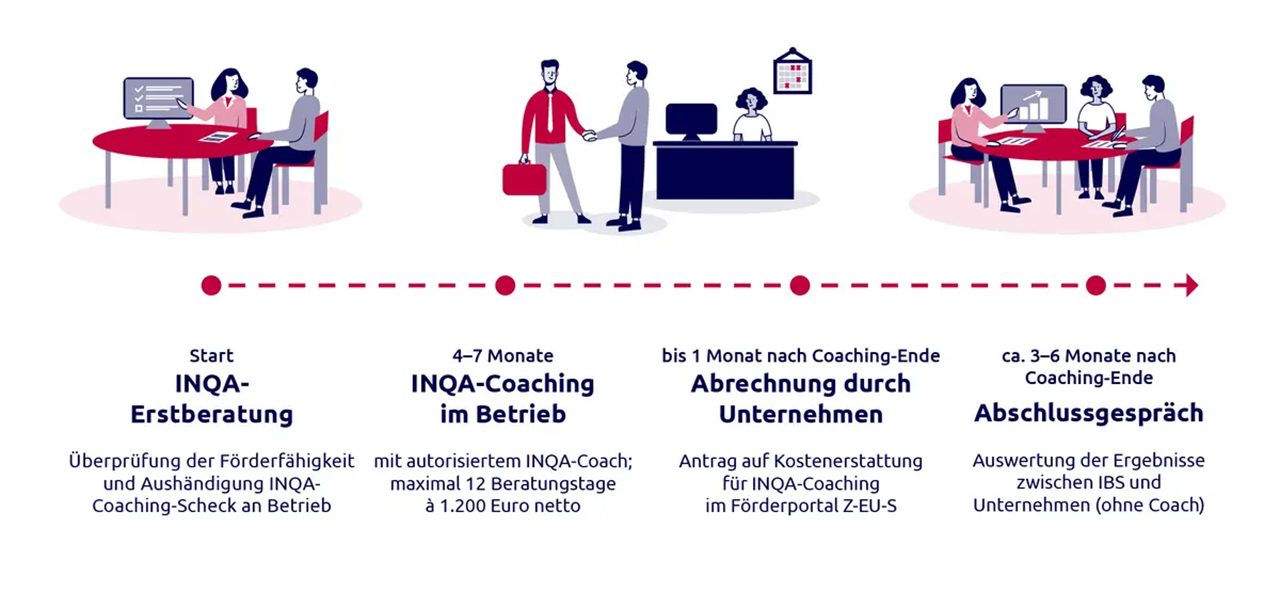
Step 1: After an initial consultation, the coach and the company representative go to the INQA initial consultation center. After the formalities are checked, the company receives the coaching voucher and the coaching can begin.
Step 2: Within 4 - 7 months, the INQA coaching then takes place at the company with up to 12 consulting days at 1,200 euros each (how this works in detail will be explained shortly).
Step 3: At the end of the coaching, the application for reimbursement is submitted. The coach typically gathers all the necessary documents and prepares the application for the company.
Step 4: After 3-6 months, a final meeting takes place with the initial consulting agency, in which the company describes the progress that has been achieved through the coaching.
The role concept in INQA coaching
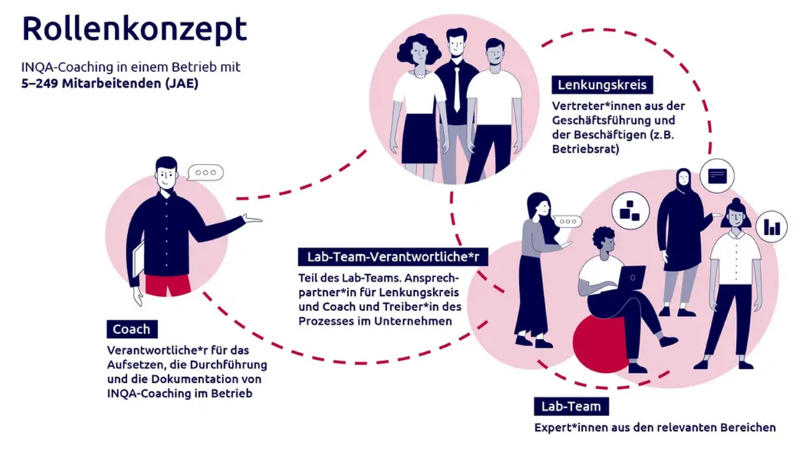
The INQA coach acts as a moderator. He coordinates the implementation of the project and ensures the documentation (which is important for the subsequent reimbursement claim).
The innovative work in the project is carried out by the lab team , which is composed of employees from the areas relevant to the project topic.
The management and the works council (if there is one) form the steering team , which only gives guidelines at certain points.
This role concept ensures that employees are involved and can contribute their expertise from practical experience as idea generators. As a result, practical knowledge from "on-site" flows into the project work, leading to very high acceptance of newly introduced processes. In this respect, an INQA coaching project differs significantly from conventional consulting projects, in which only consultants, management, and a few executives set the course.
Agile project work
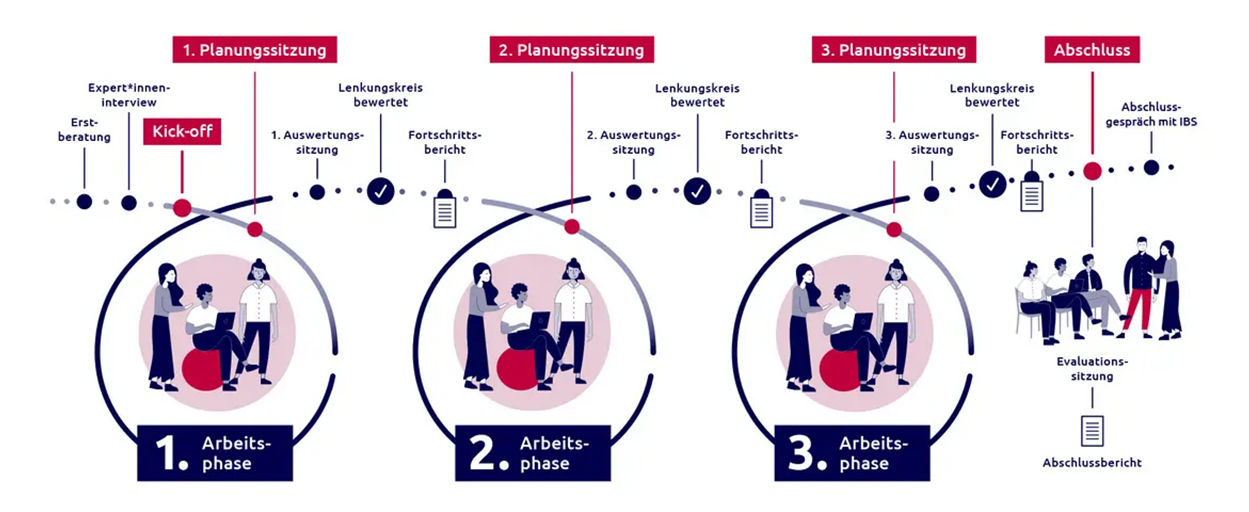
The INQA coaching process has several work phases with upstream and downstream tasks:
Following the initial consultation and the issuance of the coaching checklist, the project work begins within the company. First, the INQA coach conducts interviews with management and selected experts to define the project goal more precisely and to select the participants for the lab team.
Afterwards, a kick-off meeting is held in which all participants agree on the project goals and the following work phases are discussed.
Phase 1 of the work begins with a planning session in which the lab team plans its work steps.
After about 1 month, an evaluation session is held in which the lab team compiles and discusses its work results.
The results are then presented to the steering team, which may change course.
The results of the steering committee meeting will be compiled in a progress report.
The planning meeting for work phase 2 follows, which in turn lasts approximately 1 month.
Afterwards, the steering team will evaluate the results of the second work phase and, if necessary, make further adjustments.
The third planning meeting then marks the start of work phase 3, with the same procedure as the previous work phases.
A final evaluation session follows, based on which the INQA coach writes a final report.
The collected protocols and progress reports are then used to submit the reimbursement application, and the work of the INQA coach is completed.
After 3-6 months, a final meeting takes place between the company and the initial consultation center.
Evaluation of agile project work
Certainly, such a systematic approach cannot always be fully guaranteed in the actual execution of a project. However, our experience with agile project work shows that significant advantages for the company arise when an effort is made to follow this approach as closely as possible:
The expertise of employees can flow freely into the project. This significantly increases the innovative power of the solutions found and minimizes errors that inevitably occur when only consultants and managers are responsible for the project.
The skills and awareness of process responsibility grow among the participating employees. In this respect, agile projects are always also an investment in the company's human capital.
The division into clearly separated work phases, each followed by an evaluation by the steering committee—the only body where management is represented—allows the lab team to work independently without interference from executives. At the same time, it creates a certain obligation for the lab team to reach a conclusion at set deadlines, document the results, and present them to the steering committee. This prevents the situation, as in many conventionally managed projects, where work continues indefinitely without concrete results.
Questions about this topic? Reach out to us - the intro call is free and without obligation.
Schedule callComments
No comments yet. Be the first!