Leadership practiceAugust 25, 2022
Manager feedback as a tool for HR development and quality management

What is manager feedback?
In manager feedback, employees have the opportunity to give their manager feedback on their perception of attitude, behaviour, actions and performance. Feedback is constructive when expressed respectfully and factually, contains concrete suggestions for improvement and opens up additional behavioural options. Constructive feedback- can clear up misunderstandings between managers and employees,
- helps clarify relationships and conflicts,
- strengthens trust and team spirit sustainably,
- supports people's professional and personal development,
- sensitises self-perception.
What is behind it?
The basic idea is that a manager can only be successful if employees "follow" them. The relationship must work. That requires both sides to know what the other expects and wants. Through manager feedback the manager can develop continuously. However, employees must know how to give feedback and the manager must genuinely want to know what employees think. Manager feedback is not an assessment of leadership quality but a chance for the manager to improve it.How does manager feedback work?
Typically a manager seeks feedback from employees once a year. Companies develop a system to follow. Depending on trust, the process is more or less open. One possible path:- Feedback starts anonymously via questionnaires because of initial scepticism. The manager gets a self-assessment form; employees get a form to assess the manager.
- With more trust, feedback can be more open — e.g. employees present assessments in a workshop, followed by reflection on each point.
360-degree feedback
In this special form, superiors, colleagues, business partners and customers can also give feedback, showing different perspectives on the manager's attitude and behaviour. A differentiated external view can be compared with self-image, including actual vs. target views.Coaching for improvement
External coaches are often brought in to define measures, optimise and train, because an unobstructed view of the whole system and impartiality are essential for managers to accept feedback results.Example: manager feedback in a social services company
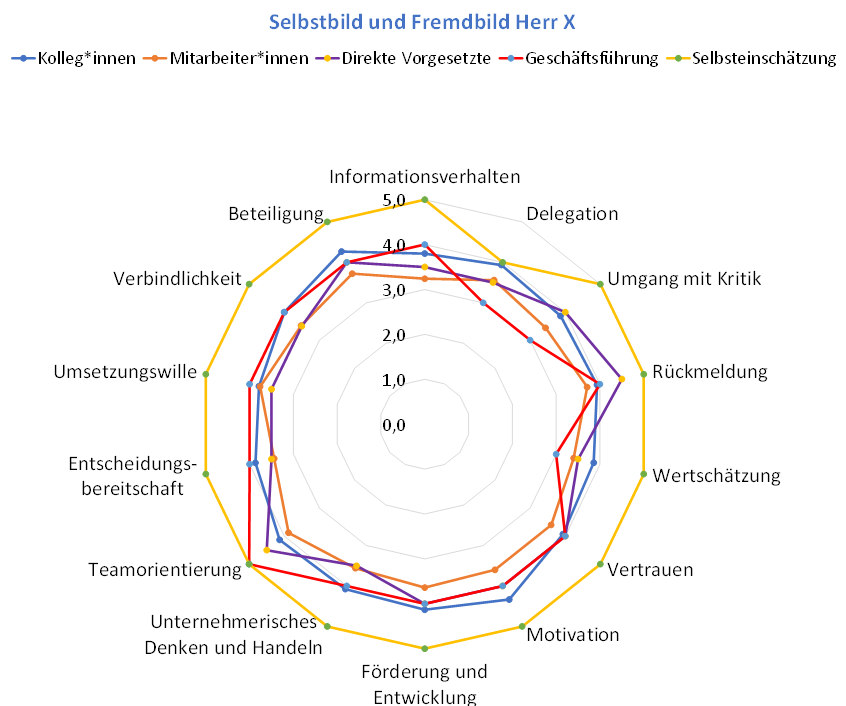
A company with about 200 employees and 10 managers, mainly offering assistance services, wanted 360-degree manager feedback to see how leadership principles set years ago were lived in practice. The overarching goal was to improve leadership quality sustainably. professore.de was engaged. Brief project outline: 1. Together with management and quality management we defined goals and framework conditions, including effectiveness of middle management, employee satisfaction with their direct manager and the company, perspectives of other managers (360-degree) and benchmarking. 2. Project conditions were agreed with the quality manager. Management chose a written survey with an anonymous questionnaire sent by post. Timely evaluation ensured employees and managers received feedback quickly, documenting management's willingness to change. 3. Questionnaires were developed — 14 short statements on one page plus self-assessment for managers. 4. professore.de sent questionnaires and collected returns to preserve anonymity. 5. After six weeks, evaluation was prepared graphically and presented to management. 6. Improvement measures were agreed. professore.de coached managers and ran team workshops. We used our mobile learning modules with scripts, explainer videos and learning success questions on key aspects of good leadership. 7. Coaching used individual spider charts (see figure below) comparing self-assessment with assessments by employees and colleagues. The coaching challenge was to foster insight that this was not a performance appraisal but an opportunity to improve leadership. In the example, the manager saw themselves as appreciative towards colleagues while employees and management were much more critical — coaching focused on appreciation and practising behavioural change.Example comparing self and external image of a manager (0: poor / 5.0: very good)
Teilen:
Questions about this topic? Reach out to us - the intro call is free and without obligation.
Schedule callComments
No comments yet. Be the first!