Understanding leadershipDecember 19, 2015
Understanding leadership – Part 14: Leadership best fit

Lessons from history
How leadership works in industry and service societies has changed sharply over 150 years. Depending on economic, political and social conditions, one leadership philosophy or another succeeded; when conditions changed, new leadership models emerged. [table id=5 /]Not best practice but best fit counts!
The way of leading you find in your company today has evolved for- a specific company
- a specific market segment
- today's time
- today's social conditions
- today's employees
Modern leadership approaches are interaction-oriented
Modern approaches assume leadership happens mutually in groups—social interaction. Subjective perception matters greatly:Leadership is no longer about absolute truth and who is "right" but accepting the other. "Everyone is right"—from their perspective—is gaining ground. The other may have their own view inspiring their actions. The question is how the I-you-he-she system can function productively.Group and individual psychology are constitutive. Leadership is an interaction relationship. Good leaders build constructive relations and try to understand the other's view.
Where should your leadership relations develop?
If "best fit" is the motto, how do you as a leader fit your organisation? (See consulting offers from professore.de.) Again, from vicious circles and clinch situations:Eventually the leader has the staff they deserve and staff have the leader they deserve. Leaders work in the company they deserve and the company has the leaders it deserves…Early on we must shape the direction of this mutual social construction—with staff and with company structures.
Change the management
When company structure and your personal leadership do not match, change is due—often a process we call "change the management" where leadership plays a key role.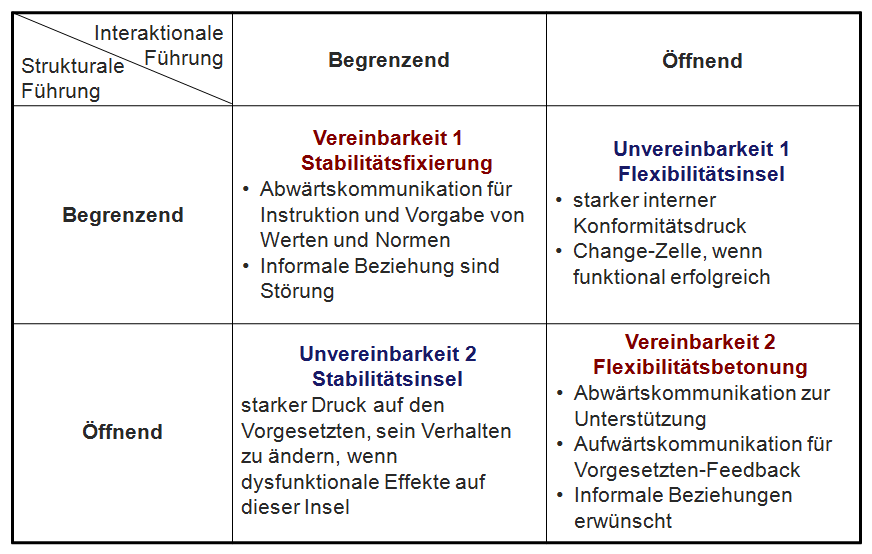 Compatibility 1 – stability fixation: If the company is strictly hierarchical, you fit here if you tell staff exactly what to do and not do. Each morning you decide each person's tasks, give instructions and check exact execution. Talking or coffee at work is forbidden—the old state is stabilised.
Incompatibility 1 – flexibility island: If you join such a company wanting to modernise, you come under pressure when out of step with structures. If your methods succeed and performance rises, you become a cell of change and can initiate change with allies.
Incompatibility 2 – stability island: The reverse: structure is to become more flexible top-down. Managers may resist; if their old style fails with staff, they often must leave.
Compatibility 2 – flexibility emphasis: Both structure and personal leadership are employee-oriented. Upward and downward communication—including manager feedback—matter equally; little needs changing at first.
For a new leader the consequences are major: you cannot immediately impose your idea of "good" leadership. First learn policies and norms; then in your sphere break patterns and step by step—with allies—change structural conditions. You act on both levels: as organisation designer structurally and shaping relations with staff interactively.
Compatibility 1 – stability fixation: If the company is strictly hierarchical, you fit here if you tell staff exactly what to do and not do. Each morning you decide each person's tasks, give instructions and check exact execution. Talking or coffee at work is forbidden—the old state is stabilised.
Incompatibility 1 – flexibility island: If you join such a company wanting to modernise, you come under pressure when out of step with structures. If your methods succeed and performance rises, you become a cell of change and can initiate change with allies.
Incompatibility 2 – stability island: The reverse: structure is to become more flexible top-down. Managers may resist; if their old style fails with staff, they often must leave.
Compatibility 2 – flexibility emphasis: Both structure and personal leadership are employee-oriented. Upward and downward communication—including manager feedback—matter equally; little needs changing at first.
For a new leader the consequences are major: you cannot immediately impose your idea of "good" leadership. First learn policies and norms; then in your sphere break patterns and step by step—with allies—change structural conditions. You act on both levels: as organisation designer structurally and shaping relations with staff interactively.Teilen:
Questions about this topic? Reach out to us - the intro call is free and without obligation.
Schedule callComments
No comments yet. Be the first!